Sunday, November 11, 2018

Armistice Day - 100 years on

On Armistice Day today, the 100th anniversary of the ending of World War 1, I wanted to look at the Burkes who fought in the war. Of the siblings who stayed at home, Michael (my grandfather) was too old to enlist and his brother Dan, who was 29 at the outbreak of war, didn't enlist. There was no conscription in force in Ireland due to opposition from Irish nationalists so enlisting was voluntary. Many Irish people would have felt that this was Britian's war and of no concern to them. However, it is estimated 200,000 Irishmen served in the British forces in WW1.

Of the siblings who emigrated, most were too old (Pat, Bill, Jack, Tom) or dead (Fr. James, Ned) to enlist. However, I have a draft cards for Bill (aged 38) and Tom (aged 39) but at that age they obviously weren't going to be posted overseas.

The last Burke to emigrate, Joe, was aged 33 when the US entered the war in 1917 and did serve in the US Army during the war. However, he was based in the southern states and wasn't posted overseas.

Of their children, three of Pat's children served in the military, two of them serving overseas that I know of. His son, John, served with US Army (602nd Engineers) from February 2018 to July 2019. He was working as a high school teacher before he enlisted. When he left the Army he entered the Jesuit Novitiate becoming a priest. Below is a picture of him (on the left) in Germany at the junction of the Mosel and Rhine rivers according to a note on the back of the photo. I think this photo may have been taken at Deutsches Eck in the city of Koblenz, a famous viewing point for the confluence of these two great rivers. 


Joe served in the US Navy. Family lore is that he was shell-shocked and never worked. However, in the 1920 census he is liviing at home with his parents and working as a clerk in a bakery company. However, I also have a record of him living in the Downey in Veterans Hospital (now known as the Captain James A. Lovell Federal Health Care Center) in 1961 so his condition must have deteriorated. Below is a picture of Joe taken in 1969.


Bill also served in WW1 but I don't have any details of his service and if he was sent to Europe.

Their brother, Robert Emmet, desperately wanted to join his brothers in the military so in May 1918, despite not feeling well, he went to the recruitment centre. When he returned, his condition worsened and, tragically, he died in December of that year. His death certificate gives the cause of death as pneumonia with influenza as the contributory factor. Maybe he was one of the casualties of the Spanish Flu epidemic which swept the world at that time and killed more people than the war had.



Tuesday, December 15, 2015

Tom and Ann Burke (Finnerty)

While in Chicago in October I met Tom Burke who has completed a remarkable family history. I loved this excerpt which tells the story of his grandparents, Tom and Ann Burke (Finnerty). Thanks to Tom for allowing me to share it.

Occasionally, a phenomenon is so grand and so endearing to so many people that it takes on a life all its own and grows and grows with the passage of time. The tradition of the “Southside Irish” is such a phenomenon. As that tradition has been passed down from generation to generation and has moved further and further away from its origins it has not lost a bit of its energy or lustre.  On the contrary, the pride of being part of that tradition seems to have increased with every new generation. The origins of that tradition lie in the 19th century migration of hundreds of thousands of poor emigrant Irish to the area south of Chicago’s loop. There they built their homes and churches and stores and worked as butchers and cops and tavern owners. Compared to what they had in the old country, Chicago was heaven and they appreciated what they had and celebrated it with abandon. It is for that appreciation and celebration of life’s good fortune that they became known, and it is what to this day, marks the Southside Irish.

Ann Finnerty had this Irish in her. Born to immigrant parents, she had learned the value of life early on when her loving father had passed away all too young. Everyday thereafter, Ann would see life for the gift it was and it made her the sweet happy person that she was. The “HMS Majestic” had brought Tom Burke to the shores of America on October 5th 1901. He had arrived with a total of $6 in his pocket. But armed with that and his own sharp mind he started a new life for himself. And as his fortunes grew in the coming years, Tom also grew into the thoughtful, mellow person that so many would know and love.

It was in 1913 that these two kindred spirits met. The occasion was at a burial at Mt. Olivet Cemetery. After the solemn occasion, there was a gathering across the road at Sullivan’s, where as was the Irish way, the family and friends had gone to lift their spirits. Surprisingly, Tom and Ann’s chance meeting at this affair would lead to courtship and marriage within a very few months. Something told them it was right and so, on June 17th 1913, they took their vows at St. Columbanus Church and moved into an apartment in the parish. There they would remain for the next 30 years.

The turmoil the world saw in those years was remarkable and frightening. It was a period of war and depression on a global scale. But this good couple, buoyed by strong tradition and faith, held course. They raised their children with optimism, knowing that somehow they would get through those difficult times.

By the time those turbulent years had passed Tom and Ann had much to be proud of and much to be thankful for. They had given all four of their children fine educations. All three of their sons had served their country during WW2 and fortunately survived. And perhaps their proudest moment had come when their daughter, Eileen, became a nun in 1935. Sixty years later she would still be serving her order in that same cheerful spirit she had learned from her parents so long ago.
During the 1940s Tom and Ann moved to a home in St Felicitas Parish. There they would live on to dote over their many grandchildren leaving them with wonderful memories of family parties with cousins, carving lamb dinners at Easter, hot chocolate on cold winter days, the smell of a fine cigar and funny little things said like “if I’d known you were coming, I’d have baked a cake”. They were a grand couple and everyone who ever knew them would remember Tom and Ann fondly.


At a seventy five year reunion at St. Felicitas, a middle-aged woman told me about the great generosity and love she had known as a child from the old couple, the Burkes, who were her neighbours across the street on 86th place. Her telling me this brought back to my mind a flood of fond memories. That’s the kind of people Tom and Ann were. You felt their kindness and good nature and it stayed with you forever.

Wednesday, September 30, 2015

Annie Burke

Looking back over my blog I realised I missed one of John and Mary's thirteen children. The missing one is Annie Burke. Annie was baptised on April 11th 1872, the fifth-born child. At a young age she went to work in Nenagh, Co. Tipperary with her second cousin, a Mrs. McGrath, who ran a grocery, bar and Post Office business. After a period working in a hotel she rented a premises at No. 2 Upper William St. in Limerick City where she operated a bar. She eventually married her landlord, John O’Donnell, who ran the City Saddlery next door on July 31st 1910. John was almost 30 years her senior and was a widower with a large grown-up family. Annie and himself went on to have three children of their own, Maureen (who died at the age of 5), Eileen and Nancy. John died in April 1929 and Annie in November 1942. They are both buried in Mount St. Lawrence Cemetery in Limerick City.

Wednesday, September 23, 2015

A visit to Capard House

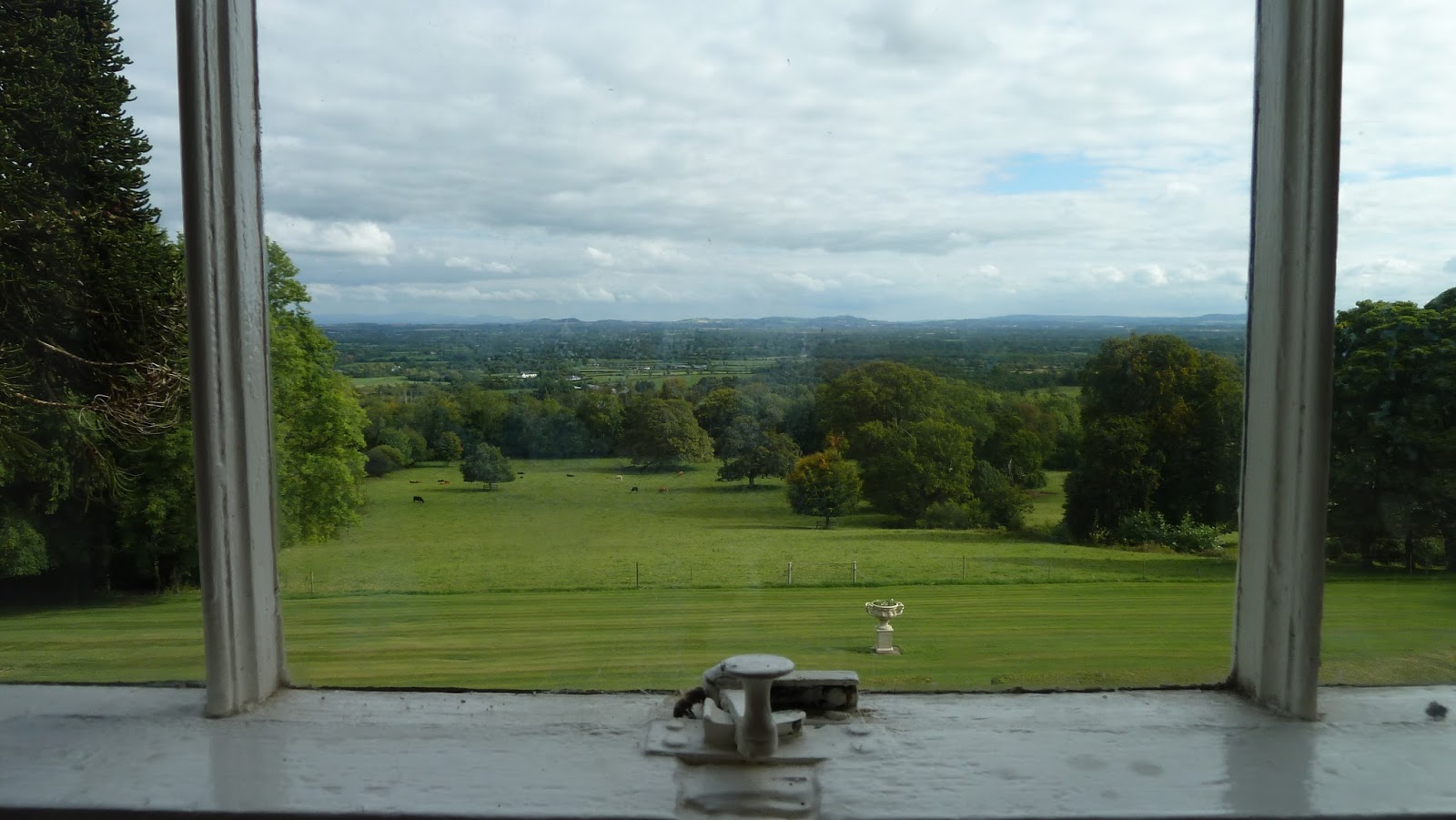
Last weekend, I visited Capard House, the home of the Pigott family who were the landlords of The Burkes of Kilmacow before they bought out their farm under the Land Acts of the late 1800s. The contents of the house are being auctioned this month as the house has been sold. The house is located on an elevated site near the village of Rosenallis, Co. Laois (about a two hour drive from Kilmacow) with spectacular views over the surrounding countryside.

Capard House

The view from an upstairs bedroom.

The rear of the house

Mary and myself at the from door!

Sunday, March 15, 2015

Remembering Mary Burke on Mother's Day

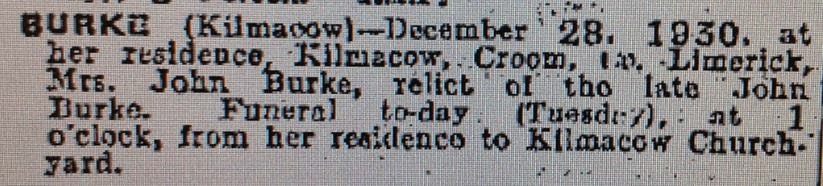
Today being Mother's Day it seems appropriate to remember Mary Burke who died on December 28th 1930. As I've outlined in previous posts she and her husband John led a remarkable life in many ways. She was born before the famine in 1843 and went on to marry John at the age of 17 in 1860.  She reared 13 children, nine of whom left to live and work in America. She only ever met three of them again and lived to see four of her children die, three in the US and her son Michael (my grandfather) who had taken over the family farm in Kilmacow. The newspaper notice of the death is very sparse and gives no hint of the life she led even referring to her in the convention of the times as "Mrs. John Burke". Funnily enough, there is no mention of a funeral Mass - she is taken from the house directly to the graveyard in Kilmacow. Anyway, there was no Mother's Day in her era but if anyone deserved a bunch of flowers she did!

John Bourke's dog licences!

Dog licences were introduced into Irish law in 1865 and the first licences were issued the following year. It cost 2 shillings per dog with an extra 6 pence in administration costs. The licences were issued in the local courts, the Petty Sessions, which were the forerunner of our District Courts today
In the first year 353,798 dog licences were issued generating over £35,000 in revenue. Subsequent years saw an average of 250,000 licences purchased. In the following decades, millions of licences were issued. The dog licences were introduced to make it easier to identify the owners of trouble making dogs, the ones which either worried sheep or damaged property. 
John Bourke is recorded as having a licence for various terriers from 1866 onwards with a "brown terrier" listed from 1897 to 1902 and a "black collie" in 1905 and 1907.
This might seem to be a banal piece of info in the greater scheme of things but it just goes to show that from the earliest days the Burkes of Kilmacow have been law-abiding people!

Sunday, February 8, 2015

John and Mary - the curtain falls

John Burke died on December 31st 1908 and Mary on December 28th 1930. They had led remarkable lives in many ways. Both of them lived through the Famine in which over a million people died of hunger and disease. They had 13 children, nine of whom left to live and work in America. Only three of them ever returned to visit. (John only ever met one of his emigrant children as Margaret and Jack returned after he died). Mary outlived three of her children who died in the US and also her son Michael who took over the family farm. Michael was my grand-father and he died in 1928. My Dad (born 1919) grew up in Kilmacow with his widowed mother and grand-mother. The fact that my Dad lived with a woman who had lived through the Famine really brings home how far we have travelled in terms of prosperity and opportunity.

The Burke Family Plot in Kilmacow Graveyard

The inscription on the gravestone

Wednesday, January 14, 2015

Dan Burke - the last of the line

Dan Burke was baptised on November 28th 1885, the last of the Burke children. According to family stories he never met his oldest brother, Pat, who emigrated before he was born. Pat gives his date of emigration in the various US census returns as a number of years between 1885 and 1890 so this story is likely to be true. 


Dan farmed the original Burke farm down the road from the Kilmacow farm at a place called the Four Gates, Dullas. Dan's uncle Patrick Burke, who lived there, had two daughters. One of them, Jane married a man called Martin Liston. However, Jane died at a young age and Martin then sold the farm to Dan, returning himself to his brother's farm (having bought it from his brother's widow). 

Dan married Bridget Reidy and they had no children. Dan died on December 28th 1952. I have a letter in my possession which his brother Tom (living in Chicago) wrote in February 1952 to his daughter Eileen. In the letter, he tells her that Dan has died and describes him as "the baby of the family". He says he is "slow in writing to Dan's wife - I should have done it already". This is not surprising as he had never met Bridget and hadn't met his brother Dan in almost 50 years. 


Bridget eventually sold the farm and it passed out of the Burke family permanently. I have no photo of Dan. In fact, I have no photo of any of the Burke siblings that remained in Ireland - Mary Ann, Annie, Michael & Dan. 


Sunday, October 26, 2014

What was it like to emigrate?

I have often wondered what was the emigrant journey like for the Burkes who emigrated. Not only were they leaving a very simple, rural way of life but they were moving to Chicago, one of the major world cities at the time. Having recovered from the Great Fire of 1871, the city would double in population between 1890 and 1920. For people who probably never ventured further than Limerick City it must have been mind-blowing to arrive in Chicago. The journey itself would have been a huge adventure and almost a holiday what with the relative luxury of the ocean going liners. However, they would have known that they were unlikely to see Kilmacow again which must have been very distressing for both them and John and Mary. Of the nine siblings that emigrated, only Jack, Kitty and Margaret ever returned for a visit. As John died in 1908 he only ever met again one of his nine children who had emigrated (Kitty in 1904). Mary lived to see Kitty (1904), Jack (1932) and Margaret (1922 & 1932) return but in her lifetime she saw three of her children die in the US (Fr. James, Kitty and Edwin). What is even sadder is that they often left in twos, Edwin and Fr. James in 1903 and Margaret and Kitty in 1904 (Kitty having come home on a visit and taking Margaret with her on her return).


The days preceding the departure must have been laden with sadness but incredibly busy as neighbours, friends and relatives called to say good-bye to the departing emigrant. The trunk would have been packed and letters written by John and Mary for the other siblings in Chicago. On the last night the emigrant would take a final stroll around the farm knowing that from now on Kilmacow would live on only in their memories.
On the morning of departure the final goodbyes would be said. Any of the Burkes that I've located on the transatlantic passenger registers left from the port of Cobh in Cork. Cobh has long been associated with the age of ocean steamliners and the Irish emigration of the late 19th and early 20th century. In 1850 it was renamed "Queenstown" to commemorate a visit by Queen Victoria. From 1848 - 1950 over 6 million adults and children emigrated from Ireland with over 2.5 million departing from Cobh, making it the single most important port of emigration. To get to Cobh the Burkes would probably have taken a pony and trap (carriage) to Croom railway station, a short distance away. Here, they would have taken a train to Cork city passing through Rosstemple, Bruree, Charleville and then on to Cork. There was a branch line from Cork to Cobh. Maybe one of their siblings accompanied them or maybe they travelled with a neighbour or relative who was emigrating also. In Cobh, they boarded tenders to take them out to the ships from a pier known as "Heartbreak Pier" for obvious reasons. The pier, though in poor repair, still stands. Having boarded the liner and sailed for the US the last bit of Irish land seen by emigrants would have been the Fastnet Rock which was referred to as the Teardrop of Ireland. 


Once they arrived in New York all immigrants were processed in Ellis Island which opened in 1892. In fact the first person through the gates of Ellis Island was an Irish girl, 15-year-old Annie Moore, who stepped off the gangplank just ahead of her younger brothers on January 1, 1892, and was greeted with much fanfare and a $10 gold coin. Here, in the Registry Room arrivals were asked 29 questions including name, occupation, and the amount of money carried. It was important to the American government that the new arrivals could support themselves and have money to get started. The average the government wanted the immigrants to have was between 18 and 25 dollars. Just outside the Registry Room is a wooden column called the Kissing Post, where new arrivals were greeted by their relatives and friends. Maybe the Burkes were met by a relative or neighbour from home living in New York. They would have then taken a train to Chicago where they would be met by their siblngs who were already there. It must have been incredibly exciting, the Burkes in Chicago seeing their siblings for the first time in years and hearing all the news and for the newly-arrived immigrant, seeing Chicago for the first time.

Living the lives we lead now it is sobering to reflect on the sacrifices made by these men and women to better themselves.


Fastnet Rock - the "Teardrop of Ireland" and the last piece of Irish land seen by departing emigrants


Sunday, April 27, 2014

Joe Burke - the last of the line.

Joe Burke was baptised on May 10th 1884. On the 1901 Irish Census he is shown as living at home in Kilmacow with his parents, brothers Michael, Tom, Ned and Dan and sisters Mary Ann and Margaret. By 1904, Tom, Ned and Margaret would be in America and Mary Ann would have married leaving him to work the farm with his brothers Michael and Dan. His father dies in 1908 and in 1909 he heads for America.
Joe travelled on a ship called the "SS Caronia" (a Cunard liner) which sailed from Queenstown (now called Cobh) on September 15th, 1909 arriving a week later in New York on the 22nd. On the ship’s manifest he gives his age as 20 even though he was 25 but many of the Burkes knocked a few years of their age with many of them having incorrect birth years on their gravestones. For the emigrants it may have been to do with making themselves more employable or eligible for certain jobs. Joe gives his home town as Croom and his next of kin as "Mother - Mrs Mary Burke, Croom, Co. Limerick”. He lists his occupation as "farmer" and his onward destination as "Chicago". He has a ticket for onward travel to Chicago and is joining his brother Thomas Burke who lives at 3431 Butler St. Chicago. He is described as being in good health, 5 ft 10 inches in height, fair complexion, brown hair and blue eyes.

According to his son, Jim , he had read that the streets of America were paved with gold! An uncle met him in New York when he landed and took him to a bar where he bought him two shots of whiskey before putting him on a train to Chicago. The Burkes met him off the train in Chicago and the story goes that he was taken to Gaelic Park where he took to the field for a hurling match. The hero of the day, he was carried from the pitch shoulder high!

In the 1910 US Census he is living with his brothers Ned and Tom and sister Margaret at 120 East 56th St. and is working as a railroad clerk. As is now customary for the Burkes he has knocked 5 years off his age. During WW1 he served in the southern states with the US Army. In 1920 he is lodging with a widow called Katherine McLoughlin and her family. He is now working as a shipper for the US government. Sometime after this he joins the Chicago Police Department.

On October 11th 1922, Joe married Lucy Butler. Lucy was born in Indiana to an American-born father and a German mother. By the 1930 census they are living at 8844, Morgan St. in a house that they own (worth $9000) and they have three sons, Joseph, James and Richard. Lucy’s brother and brother-in-law are lodging with them. Joe gives his age as 37, only knocking 9 years of his true age! Joe is now a sergeant in the Police Force and Lucy is working as a book-keeper in the bank.

By 1940 they are living at 10945, Edmondus Street. They also own this house with a value of $5,000. Lucy and Joe have two more sons, John and William. Joe only knocks off 5 years in this Census.


Lucy died of cancer on December 16th 1954. Joe had retired from the Police Force on November 1st 1947. He died on February 6th 1963. Joe is buried along with Lucy in Holy Sepulchre cemetery, the only one of the American Burkes not to be buried in Mount Olivet. His death notice in the Chicago Daily Tribune is poignant in that, as the last of the Burkes,  it name checks all his dead siblings – “brother of the late Patrick, Mary Ann, John, Michael, William, James, Hanna, Thomas, Kitty, Margaret, Daniel and Edward”.
Joe Burke's death notice - "Chicago Daily Tribune

Sunday, March 23, 2014

Margaret Burke

Margaret was baptised on April 14th 1883. She appears on the 1901 census as a 15 year old, another example of the Burke’s cavalier attitude to birthdays! She emigrated to the US in 1904 in the company of her sister Kitty. Kitty had emigrated around 1890 but obviously returned home for a holiday and Margaret travelled with her on her return (See post on Kitty on November 13th 2013 for more info). Margaret always said that she arrived in the US in the “Year of the James” as Pat’s son James was born that year as was Bill’s son, James Desmond. By 1910 she has trained as a stenographer and is working in a law office. She is living with her three brothers, Tom, Ned and Joe at East 56th St., Michigan Aveue. She now claims to be 22 (a good 5 years off the mark!).

I haven’t been able to find her in the 1920 / 1930 census returns but by 1940 she is living with her brother Bill (whose wife, Agnes, had died at this stage) and his daughter, Catherine and son Thomas. According to Catherine she was very good to the family after their mother’s death and they all thought a great deal of her. She is now in complete denial about her age and claims to be 40 (17 years gone at a stroke). She now works as a stenographer at the PWA office and earns $1440 annually. The PWA office may be the Public Works Administration, a public works construction agency set up in response to the 1930s Depression.
Margaret returned to Ireland in 1922 and according to her niece, Catherine, she had trouble returning to the US due to what Catherine calls “the Black & Tan uprising”. However, what actually was going on at that time was the Civil War which broke out immediately after the War of Independence between the majority who supported the Anglo-Irish Treaty which had ended the war and those who opposed it. Over the summer and autumn of 1922 there were large-scale military operations in the south as the Pro-Treaty forces regained control of cities like Limerick and Cork. This must have prevented Margaret getting to Queenstown in Cork, the nearest port for transatlantic crossings. She would then have had to go to Dublin, catch a boat to Liverpool and join her ship there. She arrives in New York on October 22nd on the “SS Baltic”. She gives her nearest relative in Ireland as her sister Annie in Limerick City and declares that she is travelling back to her brother Jack. Her brother Joe got married to Lucy Butler in Chicago on October 11th that year and I'm presuming Margaret intended to be home for that so she was delayed quite a bit. She also came home in June, 1930 with Jack for the Eucharistic Congress in Dublin.

She also worked for the Federal Government in Washington DC and on her retirement in 1953 she came to live in Chicago with her niece, Catherine. Her grand-niece, Pat Scumaci, remembers her as a very sweet lady with a “soft, lilting accent”. She tells the story of Margaret visiting them one Christmas. Pat asked her if she’d like to see the toys she’d gotten for Christmas and Margaret having replied – “Oh, ‘twould be lovely” was held captive by Pat for an age as she showed off her presents. 
She died on October 11th 1958 and is buried in Mount Olivet cemetery.
Figure 1 - Margaret as a young woman

Figure 2 - Margaret in later years - does anyone recognise the building in background?

Wednesday, March 5, 2014

Ned Burke - a life cut short by TB

Ned (Edward) was baptised on November 6th 1880. He emigrated to the US in 1903 arriving in New York on October 22nd on the SS Campania with his brother, the newly-ordained Fr. James. On the ship’s manifest he gives his occupation as “farmer”, is said to be carrying $50 and gives his brother Bill’s address in Chicago as his destination.
He was reputed to be a very good hurler and played on a Kilfinny team of the 1890’s and also on a team in Chicago that his brother Bill managed.
In the 1910 US Census he is living on East 56th St. Michigan Avenue with his brothers, Tom and Joe and his sister, Margaret and gives his name as Edwin. He is working as a railroad clerk.
At some point he moves to Texas to work as a railway clerk where he dies in 1917 of tuberculosis. His death certificate (see below - just click on the image to enlarge it ) shows that he died of pulmonary tuberculosis in the Bexar County TB Colony. The attending doctor had been treating him almost three weeks but the death certificate states that he had been ill for three years and had contracted the TB in Chicago.

He was only 37 and died a lonely death a long way from Kilmacow. John and Mary Burke had now lost three of their children, all three of whom had died in the US, two of them from TB. He is buried in the family plot in Mount Olivet Cemetery in Chicago.


Sunday, November 24, 2013

Kate Burke


Catherine (aka “Kate” or “Kitty”) Burke was baptised on February 13th 1870. According to the 1900 US Federal Census she emigrated to the US in 1890 at the age of 20. In 1900, she is living with her brother Pat, his wife Hannah and their three sons. Interestingly, she gives her birthday as July 1874 knocking 5 years of her age! At this point she is working as a bookkeeper.
She was reputed to be very beautiful and amongst my Dad and his siblings this was the only folk memory of her as she died in 1908 before any of them was born.
While researching her sister Margaret recently I came across a very interesting record of Kate. I had found a record of Margaret’s emigration to the US in 1904. She had travelled to the US at the age of 21 on the passenger ship the “Umbria” arriving in New York in September. I usually scan the other names on the page to see if there are any neighbours or relatives travelling with them. This time I struck gold when I found Kate on the same page. She obviously travelled home to Kilmacow and then returned to the US bringing her sister with her. They both give their brother Pat’s address as their destination and they both declare they are carrying $50. Kate gives her occupation here as “servant”. One can only begin to imagine the conflicting emotions of her parents. 14 years after she left, their daughter turns home on a holiday only to leave again carrying their other daughter.
The picture above was sent to me by Jim Burke (her nephew - Joe Burke's son). It was taken on May 28th 1904 - was it taken to be given as a gift to her parents when she travelled home that summer?
Catherine died on October 1st 1908 and is buried in the family plot in Mount Olivet cemetery.

Sunday, October 13, 2013

Bill & Agnes Burke - Portrait Photos


The last post featured Bill ("WJ") Burke and his wife Agnes. Bill's great-grand-daughter, Kim Burke Murray,  has kindly sent me on these two beautiful portrait photos of Bill and Agnes.

Sunday, September 8, 2013

Bill Burke, also known as "WJ"

 
R to L - Bill Burke, his son Des, daughter Catherine and his son Tom. His other son, Bill is out of frame.
 
Bill Burke was born on May 5th 1879 according to his daughter Catherine. He is the only one of the family for whom I cannot find a baptismal record. I’ve even tried the neighbouring parishes but no luck yet. As for all the other Burkes his birthday is a moveable feast. Over the 8 historical records I have for him his year of birth is given as 1877, 1878, 1879, 1880 or 1883 with 1878 being the most popular choice! In the two draft registration cards I’ve seen he gives two different birth dates – 21/3/1878 & 3/5/1878. According to Catherine, when they were they young they used to ask him how old he was and he would reply – “old enough to vote” – as a result they were never sure how old he was. Catherine comments that she “found out in later years that none of our Burke relatives liked to discuss ages”! Once when her brother Des brought his son Tom, then aged around 2 and starting to talk, over to the house, Tom Jnr. greeted his grandfather with “grandpa”. Bill replied – “Never mind the Grandpa, call me “WJ” and from then on Des’s children always referred to him as WJ.

He used to tell the children about the delicious Christmas cakes his sister in Ireland, Mary Ann, used to make and also talked about going to the races in Kilfinny with his brother Jack. Bill emigrated around the turn of the century to the US. In the 1910 US Census he gives his year of arrival as 1900 but in the 1920 Census he gives it as 1897. According to his daughter, Catherine, he arrived in 1899 and stayed with his brother Jack. However, I think he probably arrived after June 1900 as he isn’t listed on the 1900 Census as living with Jack.

On October 28th 1903 he married Agnes Bridget Mitchell who came from Castlebar in Co. Mayo. In the 1910 US Census they are living at 3131 Butter Street (Butler St - ?) and they have two children, James Desmond (born 1904) and Catherine (1910). Agnes is shown as having given birth to four children of which only two are alive. Curiously, the Census entry also has a “Josephine Burke” listed but there are no details and there is a line through her name. Had she been born recently and died as an infant? They went on to have two more children, Bill (1912) and Tom (1916). Catherine vaguely remembers her father taking Des to hurling games at Gaelic Park – Bill was manager of the team. Bill’s brother, Ned (Ed) also played on the team. In 1910 Bill was working as a shipping clerk.

Bill’s WW1 draft registration card has Bill and Agnes living at 5130 Lowe Avenue. Bill gives his occupation as an employee of “Brotherhood Freight Handlers” Agnes died on May 16th 1919 and was buried on the 19th in Mount Olivet cemetery.

In the 1920 US Census Bill is renting at 5134 Emerald Avenue. To help raise his young family (the youngest Tom is only 4 ½) he has hired a live-in servant, Mary McGinty, an Irish lady who was a widow herself. His occupation is given as a “Checker” with a railway company – this maybe a ticket checker or something to do with maintenance. Interestingly, James Desmond is now working as a messenger even though he is only 15.

By 1930 the family is renting at 5209 South Peoria Street paying $65 a month. The Census also helpfully informs us that they had a radio! He is working as a clerical worker with a railroad company. According to the 1940 Census the family have moved to 8943 May Street and his son, Thomas, and his daughter, Catherine are living with him along with his sister, Margaret. They are still renting, paying $27 a month. The Census also tells us that he only worked 15 weeks in 1939 earning $414 – maybe he had health issues or was unemployed for a period. His WW2 draft card shows him still living at 8943 S. May and he is now listed as “unemployed” .

Bill died on July 1st 1949

Sunday, February 10, 2013

Tom Burke

 
                  Tom & Anna with their daughter, Sr. Eileen, their daughter-in-law Rita and her children, Jane, Julie and Kevin.

Tom Burke was born and baptised on August 24th 1878.He emigrated on September 26th 1901. All three emigration records I’ve found so far for the Burke emigrants have shown the Burke brothers emigrating in the autumn (September or October). This may be just a coincidence or it could have a practical explanation. The summer was a very busy time on the farm. Hay was harvested to feed cattle over the winter in the summer months. This was a labour-intensive job and maybe the brothers waited until this was finished to emigrate. Maybe there was a lot of work available on neighbouring farms and the brothers earned some cash for the trip. In any case, Tom travelled on the SS Majestic, a White Star liner, arriving in New York on October 3rd. On the ship’s manifest he gives his occupation as “labourer” and declares that he is joining his brother Jack (John) in Chicago. He is carrying the princely sum of $5! The SS Majestic provided an interesting footnote to the “Titanic” story. When the Titanic came on the scene in 1912 Majestic was retired from White Star's New York service and designated as a reserve ship. When the Titanic met her fate in April, 1912, Majestic was pressed back into service, filling the hole in the transatlantic schedule.

In the 1910 US Census we see that he is living with his sister Margaret and brothers, Edward and Joe in rented accommodation at 120 East 56th St. He is working as a bartender in a saloon-restaurant. As we have seen already, it was common practice for the Burkes to knock a few years of their age and Thomas is no exception. He gives his age as 26 (6 years saved!). He became a naturalised US citizen on June 25th 1910. Interestingly, on the record he gives his date of arrival in the US as “about Sept. 26th 1901”. This is actually the date he left Ireland so obviously this date is etched in his consciousness while he is unsure of the actual date he landed in New York.

On June 17th 1913 he married Anna Finnerty who had been born in Chicago of Irish parents at the Church of St. Columbanus. Tom's age on the marriage record is given as 24!

By 1920 he is living at 7116 Eberhart Avenue (renting) and seems to have come to terms with the ageing process as he gives his age as 41, only a year shy of his actual age. Anna and himself now have three children – Eileen (5), John (3) and Thomas (2). Also living with them is Anna’s widowed mother and her two sisters, Loretta and Mary (who later married Thomas’ brother Jack). Tom is working as a guard on the ‘elevated care’ – this entry is poorly legible but maybe ‘elevated rail’ referring to the elevated commuter train track in Chicago (also known as the Loop).

By 1930 according to his Census return he is living at Wabash and is working as a salesman for a radiator company. The family is still renting ($65 a month) and owns a radio set! (this may seem an inane Census question but in the Thirties this was obviously hugely significant). Anna and himself have another son, Bernard and his mother-in-law still lives with them. Tom is now “47” ( 5 years shaved from his age).

The 1940 Census return is a mine of information on the family. Tom is back working as a bartender, working 60 hours a week (not bad for a 62 year old!) and earning $1,820 a year ($35 a week). In 1939 he declares that he worked 52 weeks so not much room for holidays there. The family now own a home worth $9,000 at 7300 South Michigan Avenue. Anna’s sister, Mary, is back living with them as her husband, Jack (Tom’s brother), has died. When I first became interested in the story of the Burkes one of the people I contacted was Tom’s daughter, Sr. Eileen Burke. She kindly sent me a letter written to her by Tom on February 24th 1952. In the letter he tells her that his brother Dan has died in Ireland, describing him as the “baby of the family”. Dan would have only been 15 years when he had last seen him. He then goes on – “In one of your letters did you mention a sister from Knockaderry. Well that is about six or seven miles west of our home at Kilmacow, this is the name of our townland. (He then draws a map of all the towns in this part of Limerick). You see now Kilmacow is midway between Croom and Knockaderry is some four miles west of Ballinagarry. I have seen their old football team play many a time in Croom and Rathkeale”.

Tom died on June 11th 1962 - the newspaper death announcement is below and is buried in Mount Olivet Cemetery in the Burke Family Plot.


Tuesday, November 20, 2012

Fr. James - a life cut short by TB.


James Burke was baptised on December 4th 1876. He received his secondary education at St. Munchin's College, Limerick (the diocesan college) and from there he moved to Carlow College to study for the priesthood. He was ordained a priest at Carlow College on June 14th 1903 and celebrated his first Mass the following day. The souvenir card of his ordination is below.
 

 At this time Ireland was producing far more priests than it needed at home and many newly-ordained priests went abroad. Fr. James was one of these and he was dispatched to the Diocese of Wichita, Kansas. I’ve managed to find his emigration record. He sailed on the SS Campania on October 4th 1903 from Queenstown (now Cobh) in Co. Cork arriving in New York on October 10th. From the passenger lists we can see that he travelled with 4 other clergymen, one of whom was going with him to Kansas. He gives his homeplace as "Ballingarry" - the parish where Kilmacow is situated. He was carrying $50 with him and his sponsor is given as Bishop Hennessy of Wichita. A quick check on Wikipedia reveals that Bishop Hennessy was born in Co. Cork and emigrated to the US as a child after the Great Famine, settling in St. Louis, Missouri. He was ordained a priest and became the first Bishop of the newly-created diocese of Wichita in 1888.
 
Amazingly, I also found his brother, Edward (Ed) on the same ship (more about him later) who was heading to Chicago to stay with their brother Bill.
The 1910 US Census shows Fr. James living with his housekeeper (Mary Roidan,  a widow from Iowa whose parents were Irish) at 412 East 8th Avenue, Winfield, Kansas (same address as Holy Name RC Church).
Unfortunately, Fr. James contracted tuberculosis and died on December 17th 1910. The death notice below is interesting in that it doesn't mention any of his siblings in Ireland or his mother who was still alive.

 
The funeral notice shows that the funeral left from his brother Jack's (John) house for Corpus Christi Church and then was carried by horse-drawn carriage to the family plot in Mount Olivet Cemetery.


I have a large framed photoraph of Fr. James which came from the old farmhouse in Kilmacow. On the corner it is inscribed "Winfield, Kansas". There were obviously several copies made of this as many years ago one of Joe Burke's (Fr. Jame's brother) sons sent me some family photos, one of which was a copy of the same photo. 


Wednesday, September 19, 2012

Michael Burke - my grandfather

According to his headstone Michael was born in 1874 but baptismal records show he was baptised on October 26th 1867. In the 1901 Cenus he gives his age as 25, knocking a whopping nine years off his age. By the 1911 Census, a guilty conscience has led him to "admit" to being 42, only two years out! Michael inherited the family farm and married Mary Banks from Adare in Co. Limerick. They had six children, John, Ned (my Dad), Mary, Pat, Mick and Willie.

A local poem recalls that he hurled with the local parish of Kilfinny in the 1890s:

"Tim Day in play, sure I must say, was a hurler keen and grand.
Mick Burke today lies in sacred clay, they hailed down from the Strand"

The Strand referred to the road that ran alongside the family farm.

Michael died on Christmas Day, 1928 having suffered a stroke 9 days earlier. According to my Dad, the last job he did before he fell ill was to fix a clip on a bin of flour in the kitchen.

Unfortunately, no pictures of Michael survive. There was a tradition in rural Ireland of naming the first-born son after his paternal grandfather and it is interesting to note that there is a "Michael" or a "Micheal" (Gaelic form) in each family of grand-children.

Wednesday, August 1, 2012

Jack Burke

Jack Burke was born in 1865 and baptised on June 15th 1865. Jack, like his siblings took a very casual attitude to his age with his birth year being listed as either 1867 or 1868 on the various US Census returns and 1870 on his marriage record. Obviously, there was a little white lie to his new bride there! Bill, his brother used to recall to his daughter, Catherine, going to point-to-point races in Kilfinny near Kilmacow with him. He had a reputation for liking a drink. One evening he was going for a drink but as his mother didn’t like him drinking he went across the fields to avoid her but she spotted him and followed him knowing his destination. He saw her and sat down in the field innocently. She sat down beside him and said nothing. Jack eventually went home. Another evening on his way home from the pub and a bit drunk he lost his way and wondered into the farmyard of a man called Jim Houlihan. Jim gave him directions – "Turn left here, right there etc.”  Jack’s reply was– “Left or right Jack Burke will get home”.

He emigrated to America in either 1893 or 1894. His first wife was called Winnie Melette and they married on June 20th, 1896. Winnie died on February 20th 1931. He visited Ireland in 1932 with his sister, Margaret, for the Eucharistic Congress in Dublin. My father (his brother Mike’s son) remembers that himself and his brothers and sisters all got one pound from him, a princely sum in those days. He stayed at his sister Annie’s place in Limerick city. One morning he received a letter. Having read it he announced “Here’s a letter from a lassie and my wife not cold in the grave”.  On his return to the states he married Mary Finnerty who was a sister-in-law of his brother Tom.   

He worked on the railroads in Chicago all his life being described in various Census returns as a Railroad Clerk (1900), a  Railroad Shipper (1910) and a Railroad Employee (1920). He is described as retired in the 1930 US Census. 

From the census returns we can follow where the couple lived in Chicago over the early years of the twentieth century:

(1900) 390, 25th St. Chicago - Ward 5 - they rented this house.
(1910) 4617, Evans Avenus Chicago - Ward 6 - Jack and Winnie owned this house and had three lodgers all Scottish and working as carpenters.
(1920) 7915, Sangamon St. Chicago - Ward 32 - Jack and Winnie owned this house which was mortaged.
(1930) 8625, South Thirty Street - Ward 19 - they owned this house which was valued at $7,000

Jack died in 1933 at the age of 68 in Chicago. He was buried in Mount Olivet Cemetery, Chicago with his first wife Winnie.

Tuesday, June 19, 2012

Patrick Burke

John & Mary's second child and first son, Patrick Henry Burke, was born in 1862, being baptised on December 4th in Ballingarry Church. In the various US censuses, however, he gives his year of birth as either 1865 or 1868. This casual relationship with age is common to many of his siblings. Maybe birthdays weren't important then and people just "forgot" when they were born, maybe it was vanity or maybe it was related to their jobs and avoiding having to retire at a certain age.

According to US census returns he emigrated between 1885 and 1890, the first of the Burkes to emigrate. Family lore says that he never met his youngest brother Dan who was born in 1885 so that would lend credence to the 1885 date.  According to his granddaughter, Patricia Scumaci, Pat emigrated to New York and stayed with a man called Dempsey from Croagh, Co. Limerick (the next parish to Ballingarry). As a result of this he met his future wife, Hannah Dempsey, who was this man's niece. Within a short period he had moved to Chicago.

Patrick and Hannah married on October 6th 1892. Patrick was now 30 but gives his age on the marriage certificate as 26! They had 8 children - Alice (1890s - died as a baby), John (1893), Bill (1895), Robert Emmet (1898), Joe (1891), Tom (1902), James (1904) and Ed (1908).

A city directory (which listed residents and their businesses before telephone books came along) from 1891 give his occupation as a bartender. He moved on to run his own saloon and using the city directories I have traced his various saloons. In 1898 he had a saloon (Burke & Riordan) at 1 Edgemont Avenue. In 1905-1907 he had a saloon at 487 W 12th. In 1910–1913 he had a saloon in 4501 West Madison. He lived on this premises as this is listed as his residence in the 1910 Census. However, his saloon was destroyed in a fire and this must have happened between 1913 and 1920 as in the 1920 Census his occupation is listed as a US Post Mail Clerk. According to the 1930 census he was working as a watchman with the Street Repair Department. The various census returns for Patrick and Hannah also contain other titbits of information such as the fact that in 1930 they were renting their home (paying $50 per month) and had no radio! The 1900 census return interestingly shows that Patrick's sister, Kate, was living with them. She had come to the US in 1890 and was working as a book-keeper.

From the city directories and census returns we can follow where the family lived in Chicago over the early years of the twentieth century:
1891 - 284 5th Avenue
1898 - (Ward 9) 381 Loomis Street (Renting)
1900 - (Ward 9) 381 Loomis Street (Renting)
1910 - (Ward 34) 4501 West Madison St. (Renting)
1920 - (Ward 35) 4330 Jackson Boulevard (Renting)
1930 - (Ward 30) 4032 Wilcox Street.

According to Patricia Scumaci his house was always full of books and he spoke very precise and proper English. If any of his brothers wanted to know anything about the old days in Ireland they'd ask Pat. Patrick died on 21 Nov 1943 at the age of 81. He is buried in Mount Olivet cemetery with his wife, Hannah. It was his brother, Fr. James who had bought this plot of 15 graves. His date of birth is given on his headstone as 1865 instead of 1862